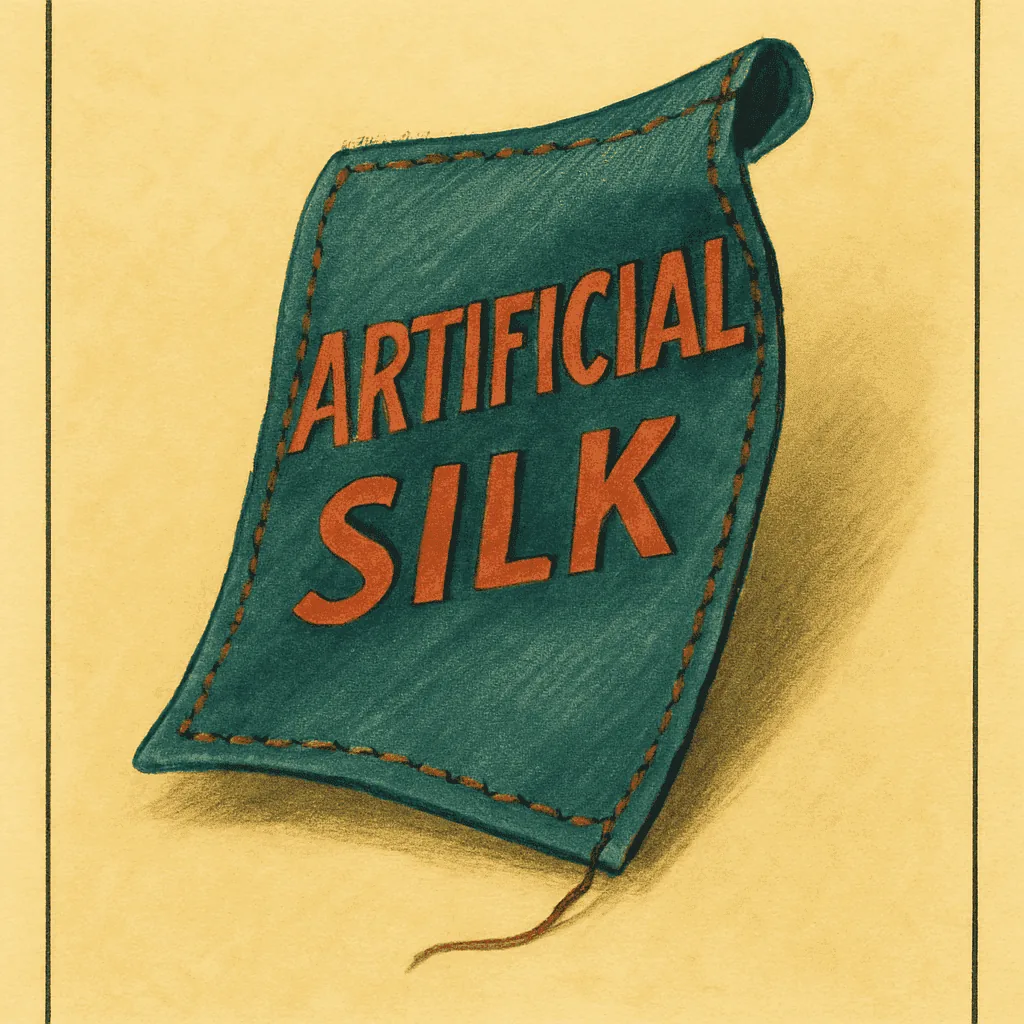
The blouse is on the bench, collar folded back, and the content label sits flat under the lamp. It reads artificial silk. Not rayon. Not viscose. The tag stock is a soft woven cotton, ink slightly bled, the serifs a little uneven where the weave took them. Two words, and the garment has already told you the outer edge of when it was made. You haven't needed the union mark yet. You haven't needed the RN. The fibre name is doing the talking here.
Most readers reach for the label last, or reach for it first and then stop reading the moment they see something familiar. Rayon feels familiar. Rayon has been rayon for as long as anyone in the room has been alive. So the eye slides past artificial silk, or reads it as a quaint synonym, and the tag stops being evidence. That is the mistake. The fibre name on a content label is not decorative. It is regulated, and it changes on datable calendars, and those calendars are one of the cleanest windows a garment offers.
Start with rayon. It was sold as artificial silk from the eighteen-nineties onward — the marketing name preceded the fibre we now call rayon by decades. The Federal Trade Commission retired the phrase in 1937; after that ruling, artificial silk comes off new labels and rayon goes on. A tag that still says artificial silk is, at the outer edge, a 1937 tag or earlier. It does not, on its own, tell you 1912 versus 1934 — the weave, the label stock, the seam finish narrow that further. But the upper bound is fixed. One phrase, one date, one wall you can put your hand on.
Acetate runs a parallel track. In the twenties and thirties it went to market as celanese in the British sphere, as a proprietary name that became a common one, the way hoover became a verb. A label reading celanese, or celanese acetate, sits in a specific commercial window before the generic term took over on regulated content tags. That transition is messier than rayon's — the trade name lingered longer, especially on linings and blouse cloth — but the presence of the proprietary word is itself the tell. A pure generic acetate content line reads later; the celanese line reads earlier.
Then nylon. Nylon is a postwar entrance on civilian tags. DuPont introduced it in 1938, wartime production diverted almost all of it, and the fibre only really appears on domestic clothing labels from the late forties onward. So a nylon content line places you no earlier than roughly 1945. Combine that with the other tag features — care symbols absent, RN number in an early range, union label present — and the window narrows sharply. Nylon on the tag plus care symbols on the tag means you are past 1971, when care symbol adoption began appearing on American labels. Nylon on the tag with no care symbols and a union mark is the late forties through the sixties. The fibre and the feature triangulate.
What this means at the bench is a habit. Read the fibre content line before the brand mark. Read it before the RN. The RN narrows to a fifteen-year window, and the care label narrows further, but the fibre name — if it uses a period phrase like artificial silk or celanese — can hand you the outer edge in a single glance. The stitch tells before the label does, and the label's fibre line tells before the label's brand does. It is a small discipline. It saves you from calling a nineteen-twenties blouse a nineteen-fifties one because the silhouette looked familiar and you never quite finished reading the tag.
There are edge cases. Reissues exist. Union shops occasionally used old label stock into the following year. A woven artificial-silk tag sewn into a later garment is not impossible, only uncommon, and the seam finish will disagree with the label if that has happened. Overlocked seams and an artificial silk tag do not belong together — that is the moment to pause and look at the inside of the collar before calling the decade. The label alone is not the verdict. The label is the first observation.
So, the blouse on the bench, artificial silk, woven tag, ink softly bled. Nineteen-thirty-seven at the latest. Earlier, probably, but the weave will tell you that. One observation, then you decide. Read the tag last only when the garment has already spoken; on fibre naming, the tag speaks first, and it speaks clearly if you let the old words mean what they meant.