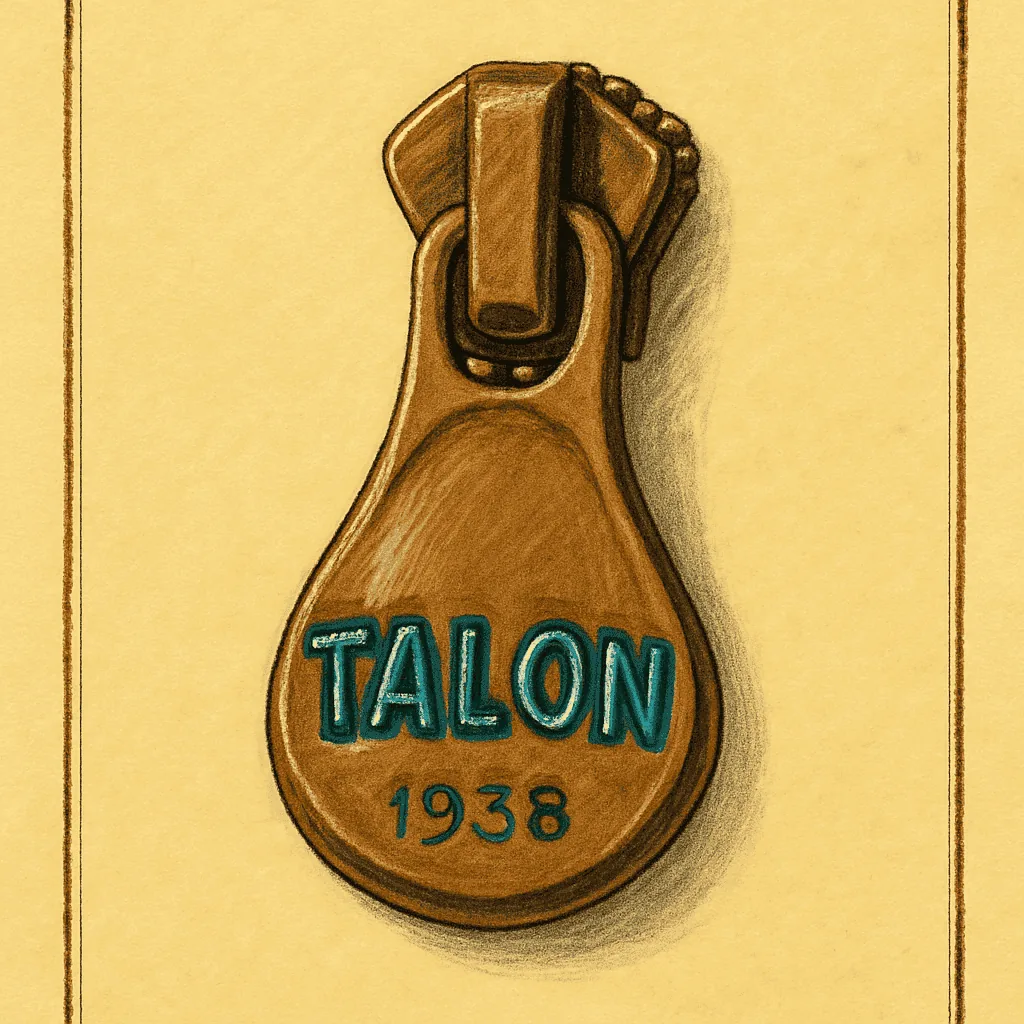
The zipper is half-open on the table, brass teeth catching the lamp. The pull-tab is a small oval, TALON stamped in relief across its face, and the metal has that soft warmth old brass gets after seventy years of hands. Nothing about the garment has been read yet. No tag, no seam finish, no fibre content. Just this: a closure, sitting there, already telling.
Most people go to the label first. It makes sense — the label is where the words are. But a label can be missing, cut out, replaced, mis-sewn from another lot. The zipper is harder to fake and harder to swap. It was chosen by the manufacturer for a reason on a specific date, and it stays. Read the closure and you have already narrowed the decade before the tag gets its turn.
Talon comes first in the American story. The company held the market from the twenties clean through to the late fifties — if the garment is American and pre-war, the zipper is almost certainly Talon, and the pull-tab shape is doing the dating. The earliest tabs are small, rectangular, unmarked or lightly stamped. Through the thirties the tab grows a touch and the word TALON appears in a plain serif, often in relief on brass. By the forties the stamp is cleaner, the tab a rounded oval, and the teeth are still brass because zinc and aluminium had other places to be. A brass Talon with a rounded oval tab and a crisp serif stamp reads forties, comfortably.
The fifties Talon shifts. The tab flattens, the shape becomes more rectangular again, and you start to see aluminium teeth on lighter garments — dresses, blouses, summer trousers. The stamp goes sans-serif on some runs. If the tab reads TALON in a clean sans and the teeth are silver-toned aluminium, the earliest that garment sits is roughly the mid-fifties. Not before.
Conmar is the narrower window, and the one people miss. Conmar ran alongside Talon from the thirties but the recognisable Conmar pull — a chunkier tab, often with CONMAR stamped in relief and a small reinforcing bar across the top — is a forties-through-fifties tell on American workwear and outerwear. Military contract pieces from the war years carry Conmar constantly. If the tab says CONMAR and the teeth are heavy brass on a cotton twill jacket, you are looking at forties workwear until proven otherwise. Conmar fades through the sixties and is gone commercially by the early seventies, which makes it useful: a Conmar zipper is a hard ceiling. Nothing with a working Conmar pull is meaningfully later than the sixties.
YKK is the other ceiling, working the other direction. YKK is Japanese, founded pre-war, but the mark does not appear on American-made garments in any volume until the late sixties. Through the seventies YKK takes ground steadily, and by the early eighties it is the default closure on most mass-produced American clothing. A YKK zipper is a floor, not a ceiling — the garment is not earlier than the late sixties, and if the YKK stamp sits on a moulded plastic tooth chain rather than metal, you are past the mid-seventies at the earliest. The pull-tab shape matters less with YKK than with Talon; the stamp itself is the tell, and the tooth material narrows the window further.
One more thing about the transition. There is a stretch, roughly nineteen-sixty-eight through nineteen-seventy-four, where American manufacturers were using up Talon stock while quietly switching to YKK. A garment from that window can carry either mark, and the closure alone will not resolve it. That is when the rest of the garment has to speak — the care symbols, the RN number, the fibre content phrasing, the seam finish. The zipper narrows; the tag narrows further.
So the pull-tab on the table. Brass, oval, TALON in relief, serif stamp, brass teeth in good order. The stitching around the zipper tape is lock-stitched, no overlocking, which agrees. The tape itself is cotton, not synthetic. Nothing here contradicts a forties reading, and several things support it. The tag has not been touched yet.
That is the sequence. Closure first, seam finish second, tag last. The garment already spoke; the label is only there to confirm. One observation, then you decide.