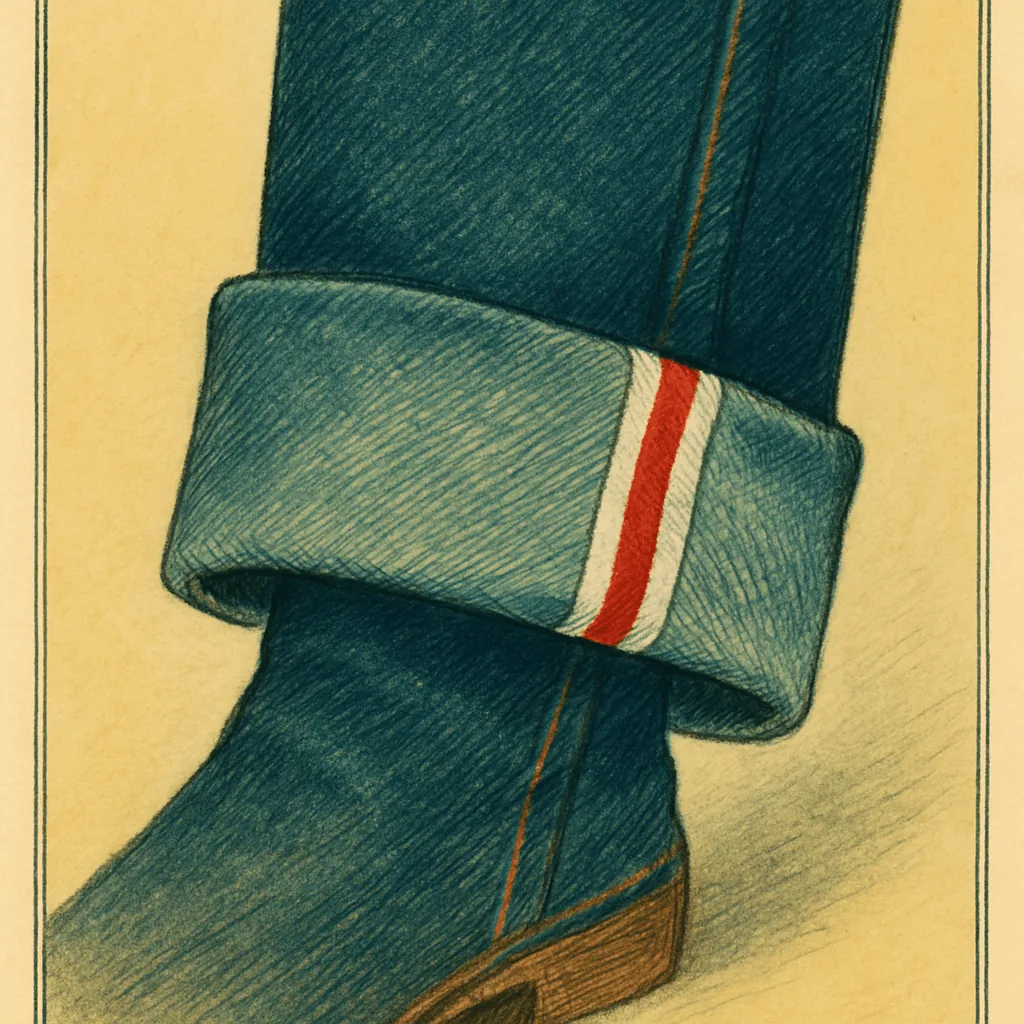
Roll the cuff of a pair of jeans, once, halfway up the shin. Look at the outseam where the two pieces of denim meet. If you see a clean finished edge running the length of the seam — a white strip, often with a single coloured line down its centre, red most often, sometimes green, sometimes yellow — you are looking at the edge of the cloth as it came off the loom. Not cut. Not overlocked. Woven that way. The mill finished it for you.
That strip is the selvedge, and most people who own the jeans do not know it is there. It sits on the inside of the leg, quiet, doing nothing you can feel. It is doing quite a lot for dating, though. Because the loom that produced that edge was a narrow one, and narrow looms went out of most American mills by the middle of the nineteen-seventies. So the strip in front of you is either from before that shift, or it is from a mill that kept the old machines running deliberately, later, for a market that had started to care again. Two very different garments. The features tell you which.
Start with the width. Shuttle looms, the ones that made this edge, wove cloth roughly twenty-nine to thirty-six inches across. Narrow. A pair of jeans cut from that cloth uses the selvedge along the outseam because the cloth is only just wide enough to fit the pattern piece — there is no waste to trim off, so the finished edge of the bolt ends up inside the leg. Modern projectile looms weave sixty inches wide and more. The pattern piece floats in the middle of the cloth; the edges are cut away and discarded. No selvedge in the seam. So the presence of the strip alone tells you the loom was narrow. The absence tells you almost nothing on its own — plenty of narrow-loom jeans have the selvedge hidden by the seam allowance — but the presence is a hard fact.
Next, the coloured line. Mills marked their selvedge with a coloured thread woven into the edge so bolts could be identified on the shop floor. Cone Mills in North Carolina used red on their Deeper Tone denim for Levi's — the line most people picture when they hear the word. Amoskeag in New Hampshire ran a different shade. White Oak plant, Cone again, ran variations across decades. A green line is not a Cone line. A yellow line is not a Levi's line. The colour does not date the jeans on its own, but paired with the pocket construction, the rivet stamping, and the back-patch material, it places the mill. Placement narrows the decade.
Then the weight and the hand of the cloth. Pre-war narrow-loom denim is denser than what came after — the yarns were spun differently, the indigo penetrated less deeply, and the wear pattern down the thigh looks nothing like a nineteen-eighties fade. Sixties and early-seventies Cone denim has a softer hand than the reissue cloth mills produced from the nineteen-nineties onward for the Japanese market. If the selvedge is there but the cloth feels slick and even, you may be holding a reissue, not an original. The stitch tells before the label does; the cloth tells before the stitch.
And only then, the tag. A red tab reading LEVI'S in all caps with the small R, or without it. A leather patch versus a paper one. A care label present or absent. Union label placement. Each of these narrows the window further, but by the time you get to the tag you already have a decade and a mill from the cloth alone. The tag confirms or contradicts. If it contradicts, the tag is usually the one lying — pieces get relabelled, reproduction tags exist, tags get sewn into later garments by people who should have known better. The selvedge does not lie. The loom either wove that edge or it did not.
So the sequence is this. Roll the cuff. Look at the outseam. Note whether the edge is finished by the loom or by a serger. If loom-finished, note the colour of the line. Feel the cloth. Then, and only then, read the tag. One observation, then you decide.
Most of the dating work is done by the time you reach the label. The label is confirmation, not evidence. The mill signed the cloth before anyone sewed a name into the waistband, and that signature is still there, on the inside of the leg, folded up under the cuff, waiting for someone to look at it in the right order.