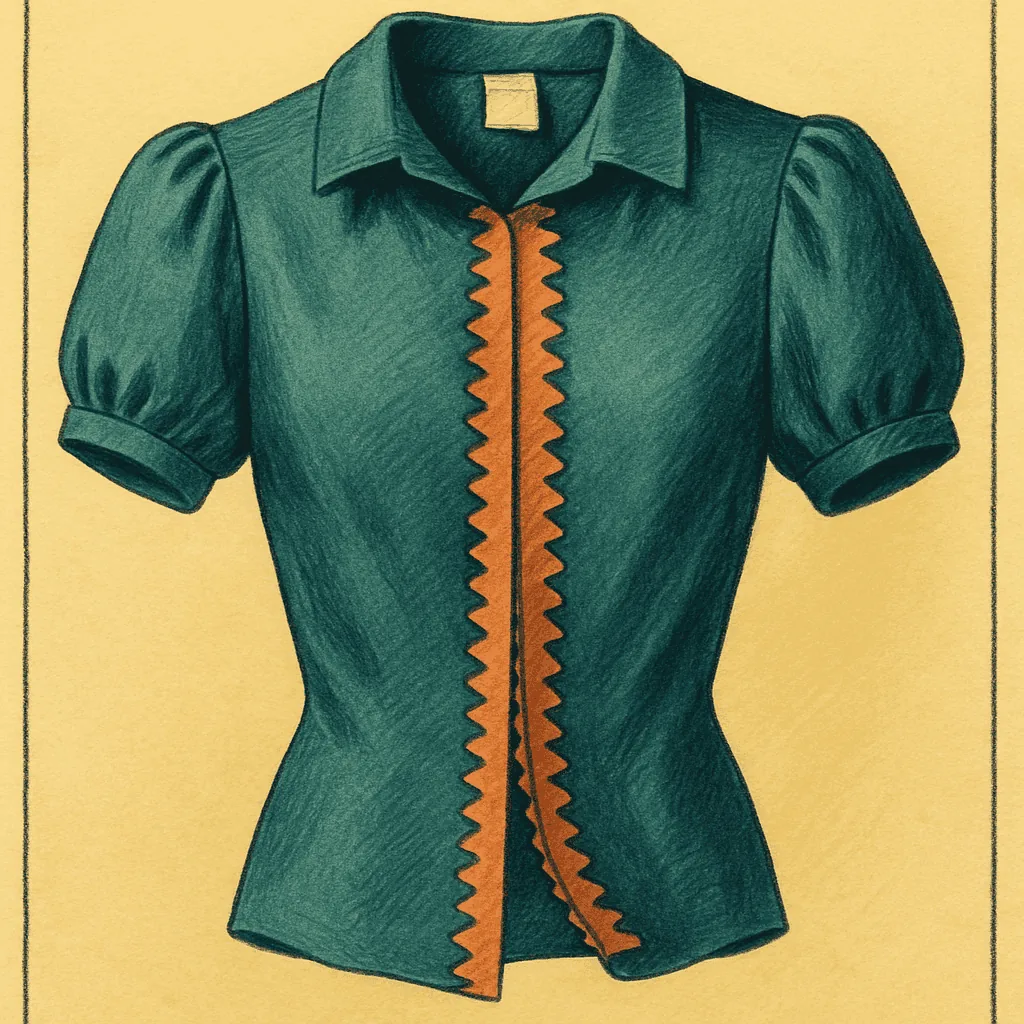
Turn the blouse inside out. Not the tag, not the placket — the side seam, where the two panels of cloth meet and the maker had to decide what to do with the raw edge. That decision is older than the label. It was made before the garment was ever hung on a rack, and it sits there in the seam allowance, unchanged, waiting to be read. Run a finger along it. The edge is either zig-zagged and clean, or it is jagged in tiny triangles, or it is folded and enclosed. Each of those is a different decade speaking.
Most dating conversations start at the tag. That is the wrong end of the garment. The tag can be replaced, restitched, added by a resale shop, missing entirely. The seam allowance cannot. It is the one part of the blouse that no one after the maker ever touches. If the tag and the seam disagree, the seam is telling the truth and the tag has a story you don't yet know.
Start with the pinked seam. Pinking shears cut the fabric edge into a row of small triangles, and the triangles keep the weave from unravelling — not perfectly, but well enough for a garment that was never meant to be washed hard. Pinking is a home-sewing finish and a factory finish both, but its factory life ends when the overlock machine arrives on the American production floor. A pinked side seam on a woven blouse, with no other edge treatment, places the garment before the overlock was standard in that category of manufacture. That is a wide window, but it is a real one, and it is a window the tag alone cannot give you.
Now the overlocked, or serged, seam. Three or four threads loop around the raw edge in a continuous chain, and the edge is bound in thread, not cut in triangles. This is the finish of factory production once the machines were in place. When you see a serged side seam inside a blouse, you are past the era of pinked-only construction in that factory. The serger doesn't tell you the exact year — factories adopted it at different times, and home sewers followed later — but it draws a line, and the pinked seam sits on one side of that line and the serged seam sits on the other.
The French seam is a different animal. Two seams, one enclosing the other, so the raw edge is folded inside itself and hidden completely. You'll find it in lightweight blouses, in silks, in fine cottons — garments where the inside was expected to be as considered as the outside. French seams survive across the century in couture and in careful home sewing, so they don't date narrowly on their own. What they tell you is register: this was a garment made with time. Read the French seam alongside the tag, alongside the fibre, alongside the buttonhole finish, and it narrows.
The bound seam is the fourth. A strip of bias tape, sometimes matching, sometimes contrast, wrapped around the raw edge and stitched down. Bound seams belong to the tailored blouse, the unlined jacket, the garment where the maker expected the inside to be seen when the wearer moved. They are common in mid-century American manufacture at a certain price point, and they thin out as serging takes over the same job faster. A bound side seam is a small statement about what the factory thought the garment was worth.
Four finishes, four different sentences about when and how the blouse was made. The pinked edge and the serged edge do most of the dating work between them, because they mark the shift from one era of factory practice to the next. The French and the bound seams live alongside those, adding register and intention rather than a tight year.
Which brings you back to the blouse in your hands, inside out on the table. You can see the seam allowance now. It is one of those four things, or a combination — pinked at the shoulder and bound at the armhole is a real combination, and it means something. Look at what you have. Name it before you name a decade. The stitch tells before the label does, and the label will still be there when you're ready for it.
Set the blouse back down. Read the tag last. The garment already spoke.