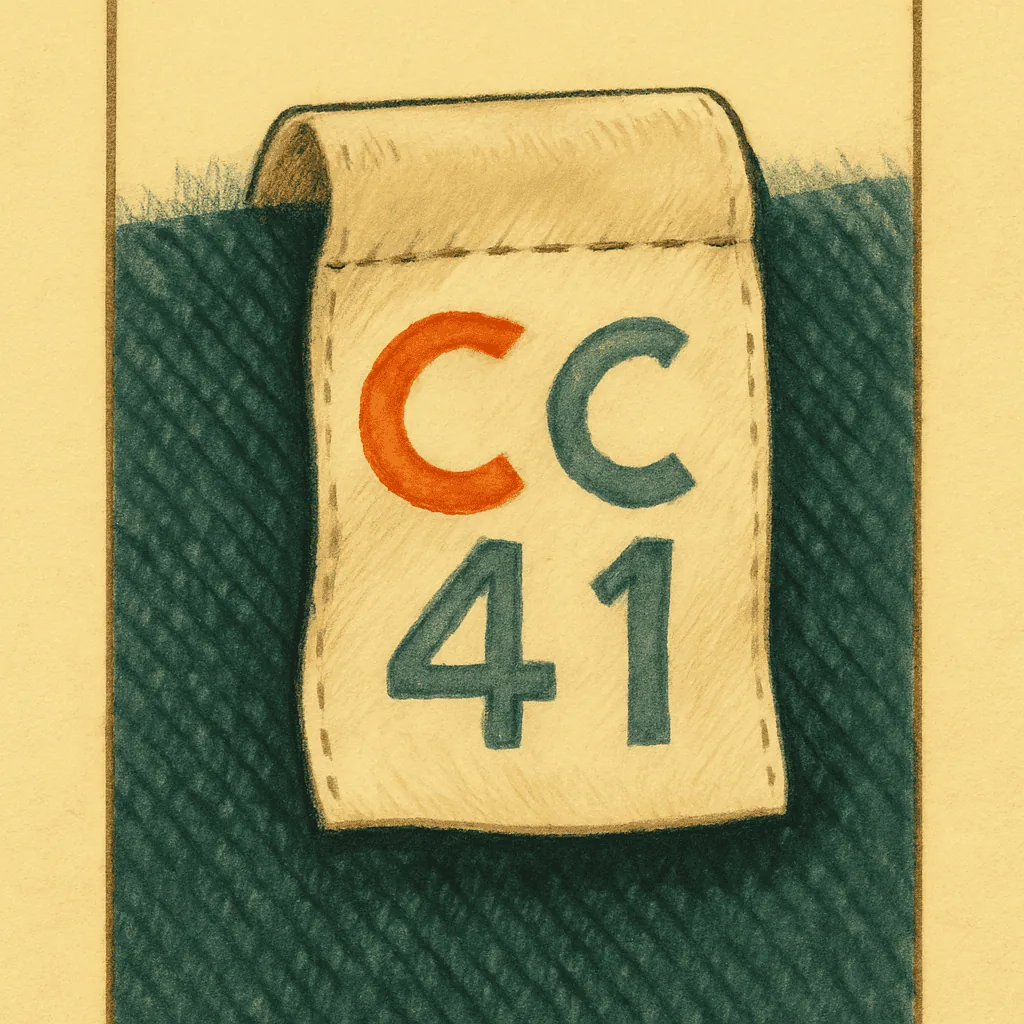
The mark sits on the inside seam or the waistband tape. Two half-moons, close together, with a number tucked beside them. CC41. It's smaller than you expect. The garment doesn't announce it. You have to turn the piece inside out and go looking, and once you know the shape, you find it in a heartbeat — a little cartoon of a cheese wheel cut twice, printed or woven into a plain tape.
Most people, when they find one, want it to mean the garment is rare. That isn't quite the reading. CC41 doesn't mean scarce and it doesn't mean fine. It means the cloth was made under a ceiling. Britain, from nineteen forty-one, capped what a coat could weigh, how many buttons a blouse could carry, how deep a pleat could fold. The mark is the receipt. The garment passed through a rule.
The American version tells the same story in a different accent. L-85, issued by the War Production Board in nineteen forty-two, wrote the ceiling into the pattern itself. No patch pockets on a jacket over a certain width. No cuffs on trousers. Skirt sweeps narrowed. Hem allowances shortened. There is no little cheese-wheel to look for on the American side — the restriction lives in the cut, not the tag. So you learn to read the cut. A wartime American jacket has a shortness at the hem and a meanness at the pocket that a nineteen-thirty-nine jacket does not.
What both marks share is the austerity of the labelling around them. A wartime utility blouse will often carry a woven label with the CC41 mark, a size, and almost nothing else. No brand flourish. No serifed logo taking up the collar band. The tag stock is thin. The weave is plain. If there's a maker's name at all, it's set small, often sans-serif, and it sits alongside the utility mark rather than above it. The garment is being catalogued, not sold.
That austerity is the tell before the mark itself. If you pick up a jacket and the inside is talking to you in three colours of woven silk — a brand crest, an address in Mayfair, a size in Roman numerals — you are not holding a utility garment. Utility labels are quiet. They were meant to be. The regulation was the point of the piece, and the label knew it.
A few things narrow it further. The CC41 mark has two forms in circulation. The original, from forty-one through roughly nineteen fifty-two, is the double half-moon. The later mark, phased in around fifty-two and used until the scheme ended in fifty-four, drops the moons for a stylised script — often read as a kite or a monogram. If you see the double half-moon, you're inside the wartime and immediate post-war window. If you see the later mark, the cloth was made under the same scheme but likely after the war ended, when rationing continued and utility became a peacetime habit rather than a wartime necessity.
On the American side, the L-85 restrictions lifted in nineteen forty-six. So a jacket that reads mean at the hem and narrow at the sweep, with a maker's tag but no fibre content, no care symbols, and no RN number in the modern format, is sitting in a window between forty-two and forty-six. Care symbols didn't arrive until seventy-one. Fibre content labelling wasn't federally required in the U.S. until nineteen sixty. The absence of those tags, combined with the cut, does more work than any brand mark.
One thing worth setting down. A CC41 mark on a garment that otherwise looks nineteen-fifties in its cut is not a contradiction. Utility cloth was issued for years after the mark's design changed, and finished garments carrying the mark stayed in wardrobes and in shops well into the decade. Read the mark as a floor, not a ceiling. It tells you the earliest the cloth could have been finished. It does not tell you the latest the garment could have been made up.
So when a wartime label comes across the table, the order matters. The weight of the cloth first. Then the cut — the pocket, the pleat depth, the hem allowance. Then the tape, and the mark on it. Then, last, whatever brand is left. The brand, in a utility garment, is the least eloquent thing on the label. The regulation did the writing.
One observation, then you decide. If it's the double half-moon, you're no earlier than forty-one and no later than about fifty-two. If it's the later script, the cloth is post-war but the scheme is still running. The stitch tells before the label does, and the label, here, is telling you a ceiling was on.