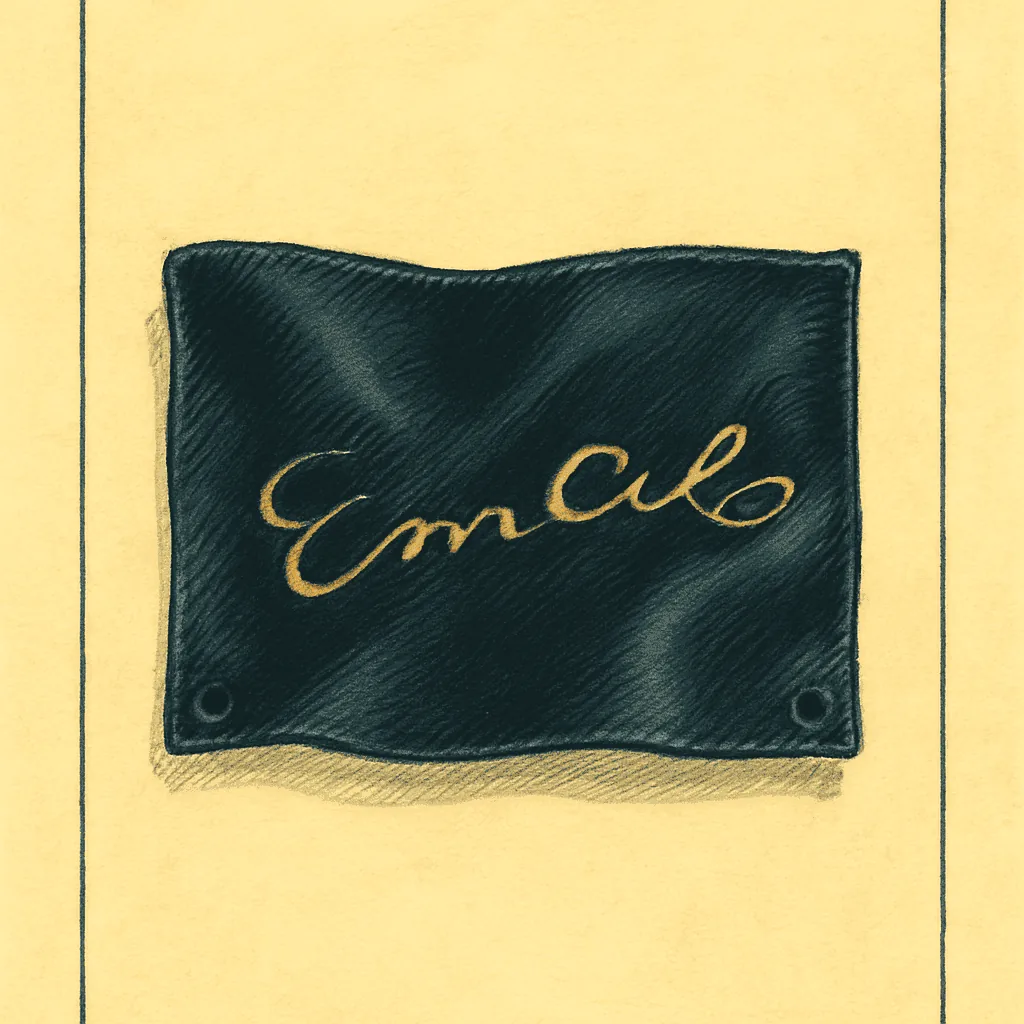
The tag is a rectangle of black satin, about an inch by three. A single name is stitched across it in gold thread, cursive, with the descender of a lower-case letter looping under the baseline like a signature at the bottom of a letter. No address. No fibre content. No country of origin. No care symbols. No RN number, no WPL number, no union mark. Just the name, and the satin, and the assumption that the woman holding the garment already knew everything else.
That absence is the whole point, and it is also the difficulty. A modern eye, trained on a wall of legally required text, reads the empty tag as incomplete. Something must be missing. Something must have been cut away. It is a reasonable instinct and it is wrong. The tag is not missing information; the tag is displaying the information it has, which is the name, presented with a confidence that we no longer have any legal room to imitate.
Start with what the label refuses to say. No fibre content — the Textile Fiber Products Identification Act does not exist yet, will not exist until nineteen-sixty. No country of origin phrasing — mandatory origin marking on garments comes later still, and the specific line about being made in a country reads differently by decade once it does arrive. No care symbols — the international care symbol system is a nineteen-seventies conversation, and even the written care instructions in English are a post-war standard. No RN or WPL number, because the registry that issues them is a nineteen-forties creation, expanded in the fifties. The tag is silent on all of it, and the silence is legal, not sloppy.
Now the tag itself. Woven, not printed. Printed labels on garments are largely a later economy; a house that could afford couture-adjacent work stitched its name into satin or grosgrain and let the loom do the work. The ground is black or occasionally cream, the thread is gold or silver or an ivory that has yellowed toward gold. The typography is script — a copperplate hand, or a looser signature-style cursive, sometimes with a small flourish under the surname. Serif capitals appear on the more architectural houses; sans-serif is rarer and usually reads later than it looks. If the whole label is set in a geometric sans, the decade is probably not the one you are hoping for.
Placement matters as much as the tag stock. The house label sits high in the garment — inside the back neck on a dress, at the top of the centre-back facing on a coat, on the waistband inside the skirt. It is meant to be read by the woman putting the garment on, or by the maid handling it. There is often nothing else in the garment at all: no size tag, because the piece was made to measure or altered in the store; no union label, unless the house was a domestic ready-to-wear operation working with the ILGWU, in which case a small woven union mark sits below the house label on the placket or the seam, and its typography is its own dating exercise.
The cloth will corroborate or contradict. Silk crepe of the period has a weight and a fall that a later rayon does not manage; rayon before the war looked nothing like the rayon we know from the sixties. Cut on the bias, the fabric hangs in a way that pattern-drafted post-war construction rarely replicates. If the tag says one thing and the seam finishes say another — a serged edge, an overlocked hem — trust the seam. The stitch tells before the label does. A convincing satin script sewn into a garment with a serger inside is a reproduction, or a later re-label, or the tag was harvested and moved.
The frustration of this decade is that the tag alone will not close the case. A cursive gold-on-black woven label with no other text is consistent with the nineteen-thirties, and it is also consistent with a small custom house working into the early forties in the same visual language, and it is consistent with certain revival labels made deliberately to look older. So the tag opens the question and the garment answers it — the weight of the cloth, the hand-finishing at the armscye, the hook-and-eye closures, the absence of a metal zipper or the presence of an early one on a side seam rather than a centre back.
Read the tag last; the garment already spoke. A house label from this decade is a small object making a large claim, and the claim is only worth what the seams underneath it will support. One observation, then you decide. If the satin is black, the thread is gold, the name is cursive, and the tag says nothing else at all — that is the visual language behaving correctly. Now turn the garment inside out and look at the hem.