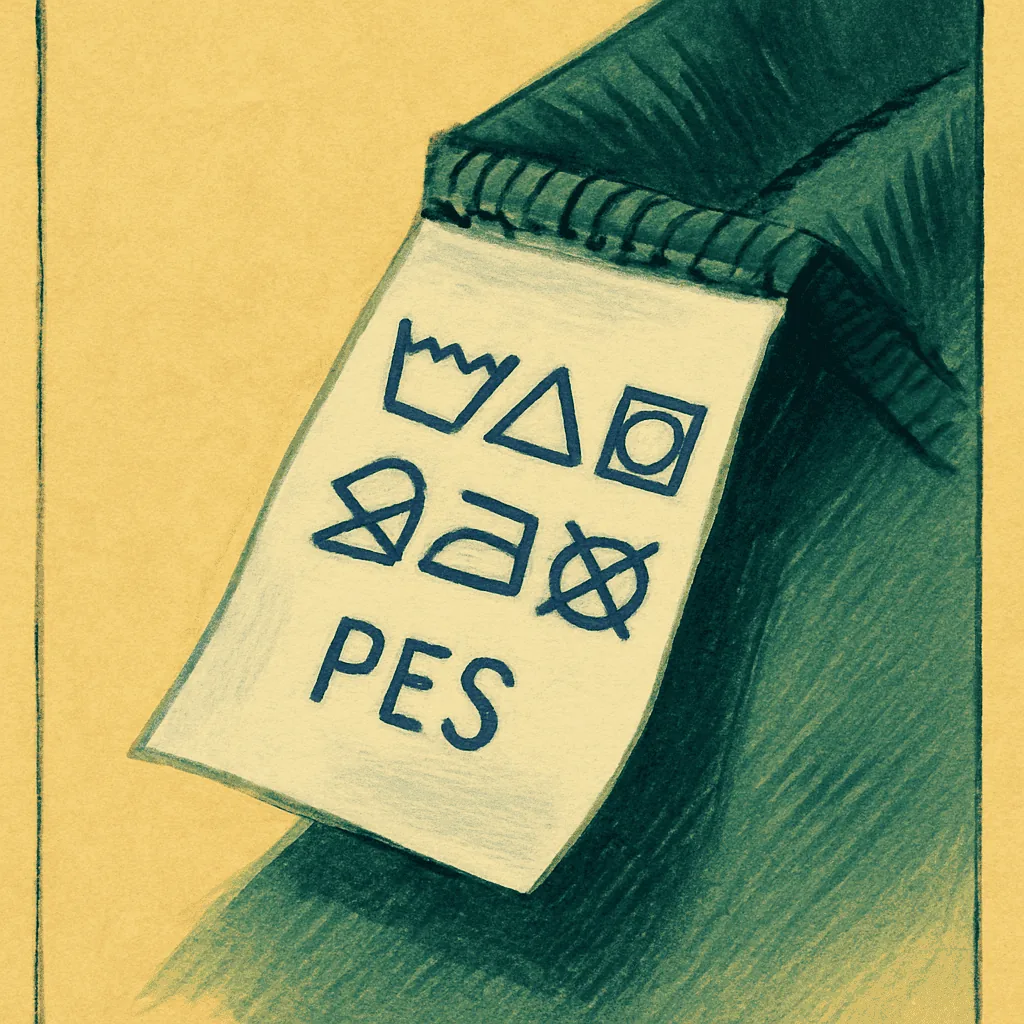
The tag is white, slick, a little stiff between the fingers. Block letters, evenly spaced, the ink sitting on top of the weave rather than in it. It says 100% POLYESTER and it says MADE IN USA and it does not qualify either statement. No blend percentages fussed over, no fibre-content apology. The tag has the confidence of a material that was, for a stretch of years, the answer to every question the industry was asking. Hold it up to the light. The weave underneath is smooth, faintly plastic, and the tag sits on it like a small placard.
The temptation is to read the fabric first and call the decade from the hand of the cloth. Polyester runs long — it was made in the fifties, it is made now — so the fibre alone tells you almost nothing. What dates this label is not the word polyester. It is how the label is built, where it is stitched, and what it is willing to say in plain paragraph form on the reverse.
Start with the tag stock. A seventies content label of this kind is a woven acetate ribbon, printed flat, cut and folded and caught into the neck seam or the side seam of a shell blouse. The edges are heat-sealed, so they do not fray. The printing is block, sans-serif, all-caps, and the ink does not bleed. Turn the tag over. The care instructions are set as continuous prose — MACHINE WASH WARM TUMBLE DRY LOW REMOVE PROMPTLY — a paragraph, not a row of pictograms. That paragraph is the tell. Care symbols were adopted piecemeal from seventy-one onward and became routine later; a tag that spells the whole care regimen out in words, with no symbol row at all, is sitting in the earlier half of the decade or the middle of it, not the end.
Now the country of origin. MADE IN USA on a polyester content label from this period is printed on the same face as the fibre statement, in the same block sans-serif, not as a separate strip. Two-tag constructions — content on one ribbon, origin on another — belong to a later habit. And look for the RN number. If it is there, it narrows the maker to a fifteen-year window on the registry; if it is absent, the tag is either very early or the manufacturer used the WPL number instead, which itself stopped being issued in the late fifties. A WPL alongside a polyester content statement is a small anachronism worth noticing. The RN, on a disco-era shell, is the more common thing.
The brands are the part people already half-know. Qiana by du Pont ran its own woven ribbon, script over a small logo, and the shirts it appeared in have that liquid drape people remember. Kodel and Dacron each had their own tag conventions, printed rather than woven, often stitched alongside the maker's own label so you get a stack of three ribbons at the seam. Nik-Nik shirts, the ones with the printed scenes across the chest, carried a printed care label in that same block face, and the placement was inside the left side seam rather than the neck. Huk-A-Poo used a woven main label and a printed content strip; the two together, in a wide-collar shell, sit comfortably in the middle seventies.
One more feature before the tag closes the case. Look at the seam finish inside. Overlocked, so we are past the sixties as a matter of course, but the specific finish on a seventies polyester shell is a three-thread serge in a matching polyester thread, tight and even, run right to the edge of the placket. The hem is a single-needle turn, machine-stitched, not blind-hemmed. None of this contradicts the tag. All of it agrees with the tag. That is what you want — the seam finish gives the decade away, and the label confirms it in plain paragraph form.
So the reading, in order. The cloth is smooth and slightly plastic. The tag is a woven ribbon, block-printed, sans-serif, all-caps. The reverse carries the care instructions as continuous prose, no pictogram row. The origin line sits on the same face as the fibre statement. An RN number, if present, sits in the registry's mid-range. The maker, if it is one of the disco-era brands, prints on its own conventions and stitches where its habit was. Nothing here is hiding. The decade is not hiding. Read the tag last; the garment already spoke.