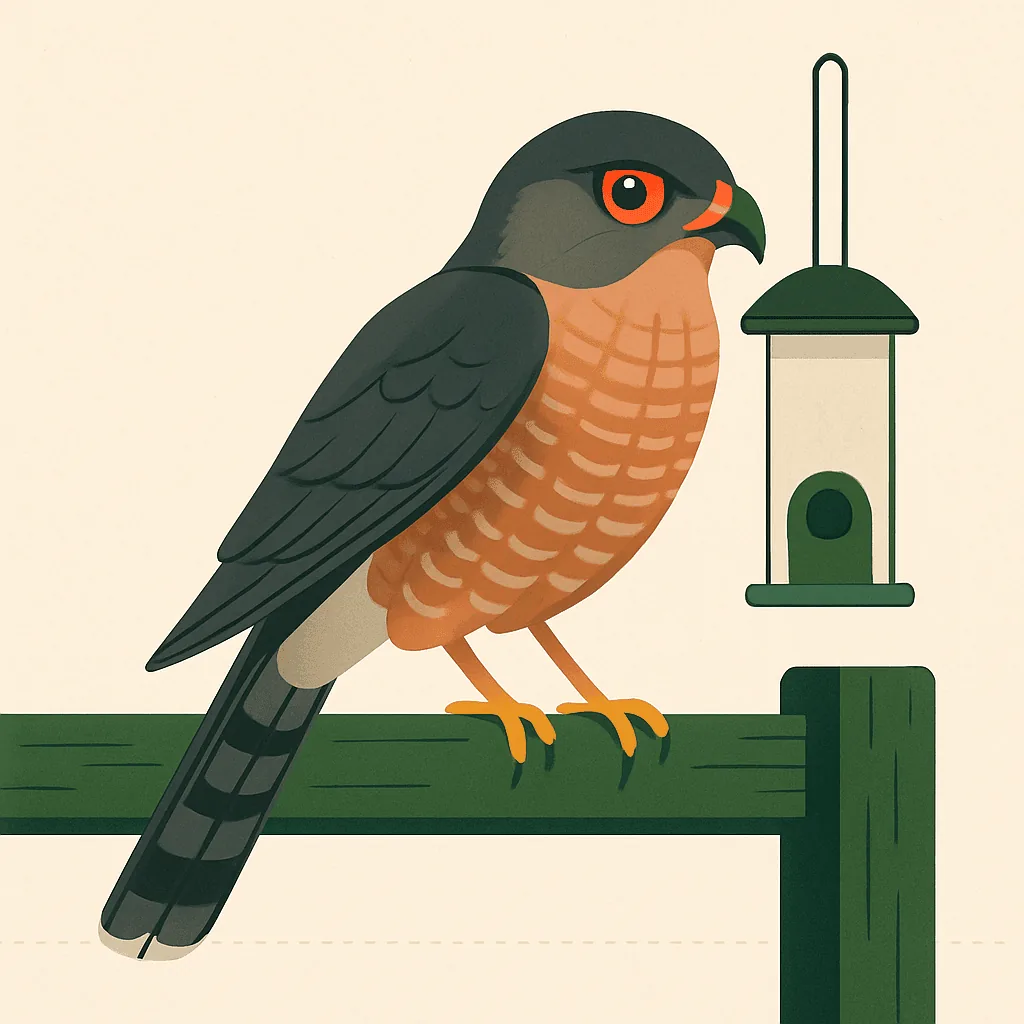
The feeder went quiet. Not the slow quiet of a full flock, the other kind. A grey shape drops onto the fence rail, and every chickadee, every junco, every house finch is gone before you finish turning your head. The suet swings on its wire. A single sunflower shell rocks on the deck. And there, on the fence, is a hawk, looking at the yard the way you look at a menu.
This happens to every feeder eventually. When it does, you have about two seconds to notice what you're looking at, because that hawk did not come to pose. Nine times out of ten in a backyard, it's one of two birds. Cooper's hawk, or sharp-shinned hawk. They are close cousins, close enough that experienced birders still argue about photos, and the shape on your fence is going to lift off before you find the field guide. So we work with what you can catch in the moment.
Start at the head. This is the tell I trust most. On a Cooper's, the head projects well out past the shoulders, giving the bird a small, blocky, forward-leaning look. On a sharp-shinned, the head barely clears the shoulders, tucked in, almost like it's hunched. Once you see it a few times, you feel it before you name it. A Cooper's looks like it's leaning into the yard. A sharpie looks like it's shrugging.
Then the tail. A Cooper's tail is longer for the body and rounded at the tip, the outer feathers a hair shorter than the middle ones, so the end looks curved when it's fanned. A sharpie's tail ends square, or even a touch notched, all the feathers about the same length. If the hawk flushes and gives you a rear view for half a second, look at the tail tip. Rounded, Cooper's. Square, sharpie. That single glance can settle it.
Size is the one most people reach for first, and it is the one that lies most often. A big female sharp-shinned and a small male Cooper's overlap. A hawk alone on a fence has nothing to be measured against. So use size last, as a tiebreaker, once you've looked at the head and the tail. If you have a chickadee still frozen on a nearby branch, that helps, but usually the yard has cleared and it's just the hawk and the wire.
How they hunt is the other clue, and this one you'll pick up over a season. Sharp-shinned hawks tend to come in low and fast, threading through the shrubs, ambushing from the hedge. They're the ones who make the whole yard vanish in a blink because they were already halfway across the lawn before anyone saw them. Cooper's hawks are a little more deliberate. They perch. They watch. They'll sit on your fence, on the shepherd's hook, on the neighbor's arbor, taking the yard in, and then they commit. If you got a full two seconds on the fence rail, you may already have your answer.
Here is the harder thing. When the hawk comes, the small birds leave, and you feel it. The feeder was busy, and now it is not, and you know why. It can help to remember that this is what a healthy yard looks like. Songbirds at a feeder mean a hawk, sooner or later. The hawk was already in your neighborhood. You just gathered the evidence in one place. She isn't ruining the yard. She's part of it.
Still, if you'd rather she moved on for the afternoon, you can help the songbirds hide, not by taking the feeder down, but by keeping cover close. A shrub or brush pile within a short hop of the feeder gives the little ones somewhere to dive. The hawk will still visit. She'll just have less easy work, and she'll go looking elsewhere sooner.
So next time the feeder goes quiet, don't rush for the app. Look at the shape on the fence. Head out past the shoulders, or tucked in. Tail rounded, or square. Perched and watching, or already gone. Two seconds is enough, once you know what your two seconds are for. And if you get a photo, even a blurry one, tilt the camera a hair and try for one more frame from below. The underside of the tail settles a lot of arguments.
Oh, and if she comes back tomorrow, she may be the same bird. Cooper's hawks especially will work a yard for days. That's a returning visitor. Worth another look.