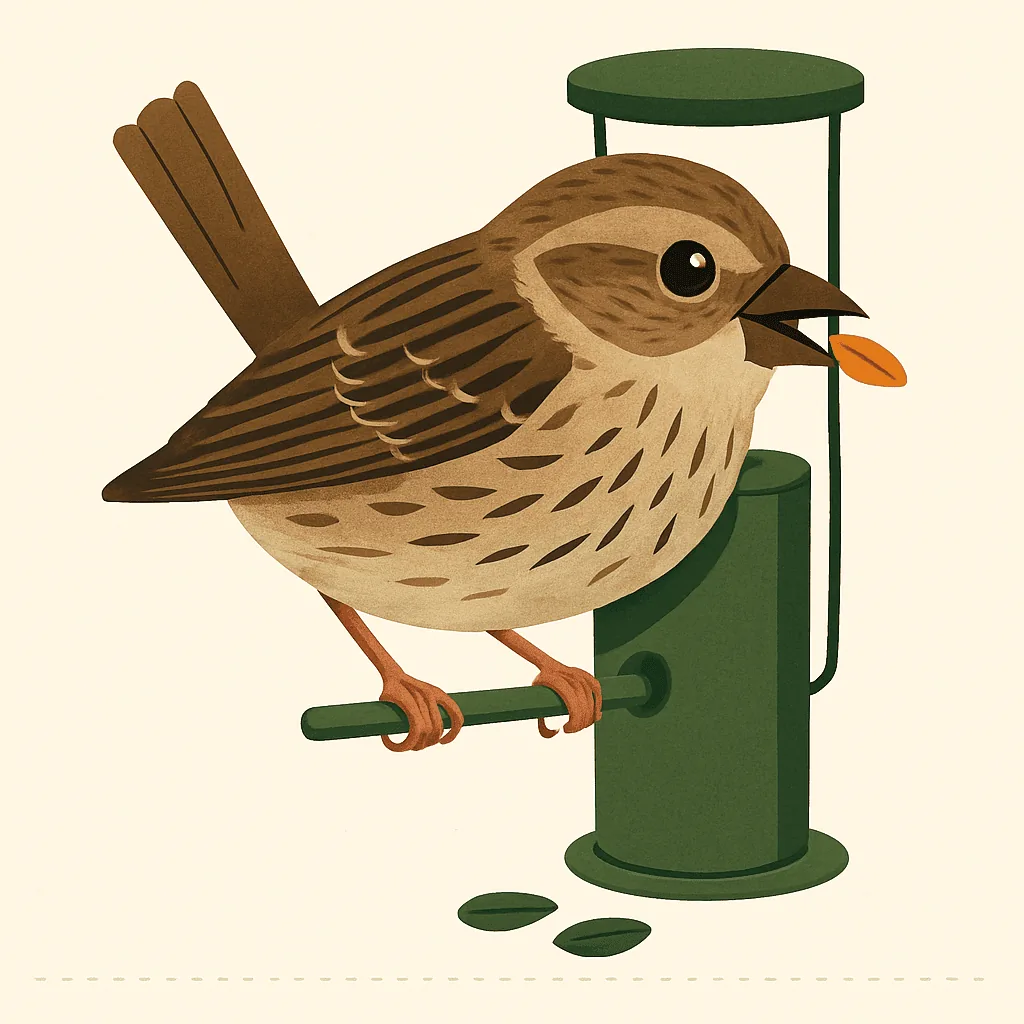
Brown bird at the feeder. Streaky chest, hopping between the perch and the ground, gone before you got a clean frame. Was that a house finch, or a house sparrow, or a song sparrow, or a chipping sparrow, or the little one with the rusty cap you almost had last week. The camera comes up, the bird leaves, and you're left with a blurry brown smudge and a question. Same one, every spring. Same one, every fall.
Field guides don't help much in that moment. They show you sixteen little brown birds on one page, each with an arrow pointing at something you can't quite see through the window. And the apps that promise a name in one tap tend to hand you a confident answer that doesn't feel right, and now you're logging a bird you never really saw. Better to slow down. Better to learn the three things that actually settle it, so the next time a streaky brown visitor lands, you already know where your eyes should go.
Start with the bill. This is the tell, and it never lies. A finch's bill is thick, short, and conical, built for cracking sunflower seeds open like tiny nutcrackers. A sparrow's bill is also conical, but softer, a little more triangular, less brute about it. And the birds people call sparrows that aren't actually sparrows, the ones with pin-thin bills, those are usually warblers or wrens passing through, and they belong in a different chapter of your book entirely. So: thick and stubby, probably a finch. Neat little triangle, probably a true sparrow. Needle-thin, look again, you've got something else.
Then look at the streaking. Not whether it has streaks, most of them do, but where the streaks stop. A house finch male wears his color on the head and chest and lets the streaks run down the flanks and belly, brown on white. A song sparrow keeps the streaks up top, crowded on the chest, often gathered into a dark central spot right in the middle like a smudged thumbprint. A chipping sparrow, by contrast, has a clean unstreaked breast and saves all its markings for the head, a rusty cap and a black line through the eye. If the belly is clean and pale, you're probably not looking at a song sparrow or a house finch. If there's a stickpin spot on the chest, song sparrow, almost every time.
Third test, and this is the one people forget. Watch where it perches and how it moves. House finches love the feeder itself, they'll sit on the perch and work a seed for a full minute, calm as anything, often in a small pair or a loose group. House sparrows do the same but bolder, chattier, usually more of them, and they'll shoulder the finches aside if the seed is good. Song sparrows almost never sit on the feeder. They work the ground below, hopping through the fallen seed, tail pumping, and when they flush they go low and short into the nearest shrub. Chipping sparrows split the difference, comfortable on the ground, comfortable on a low perch, quieter about it. So: on the feeder, calm, probably a finch. On the feeder, loud, probably a house sparrow. On the ground, tail pumping, song sparrow. On the ground, tidy and small with a rusty cap, chipping sparrow.
Put the three together and most confusions dissolve. Thick bill, streaked flanks, sitting pretty on the perch, that's your house finch. Softer bill, gray-brown, chest streaks gathered into a spot, working the ground, that's your song sparrow. Softer bill, clean pale belly, rusty cap, chipping sparrow, and a little early for one of those if it's still February. And the boldest, chattiest brown bird in the biggest group is almost always the house sparrow, which counts in your book too, even if some folks pretend it doesn't.
The trick isn't seeing every field mark at once. It's knowing which two or three questions to ask, in what order. Bill first. Then where the streaks live. Then where the bird chooses to be. After a few weeks of asking those three, in that order, the birds start naming themselves before you've fully raised the camera. Your eyes learn the shape of a finch on the perch, the pump of a song sparrow's tail, the neat little cap of a chipper. And the brown smudge on the branch stops being a smudge.
So the next streaky visitor, don't rush. Bill, streaks, perch. Add it to your book. Your book's getting good.