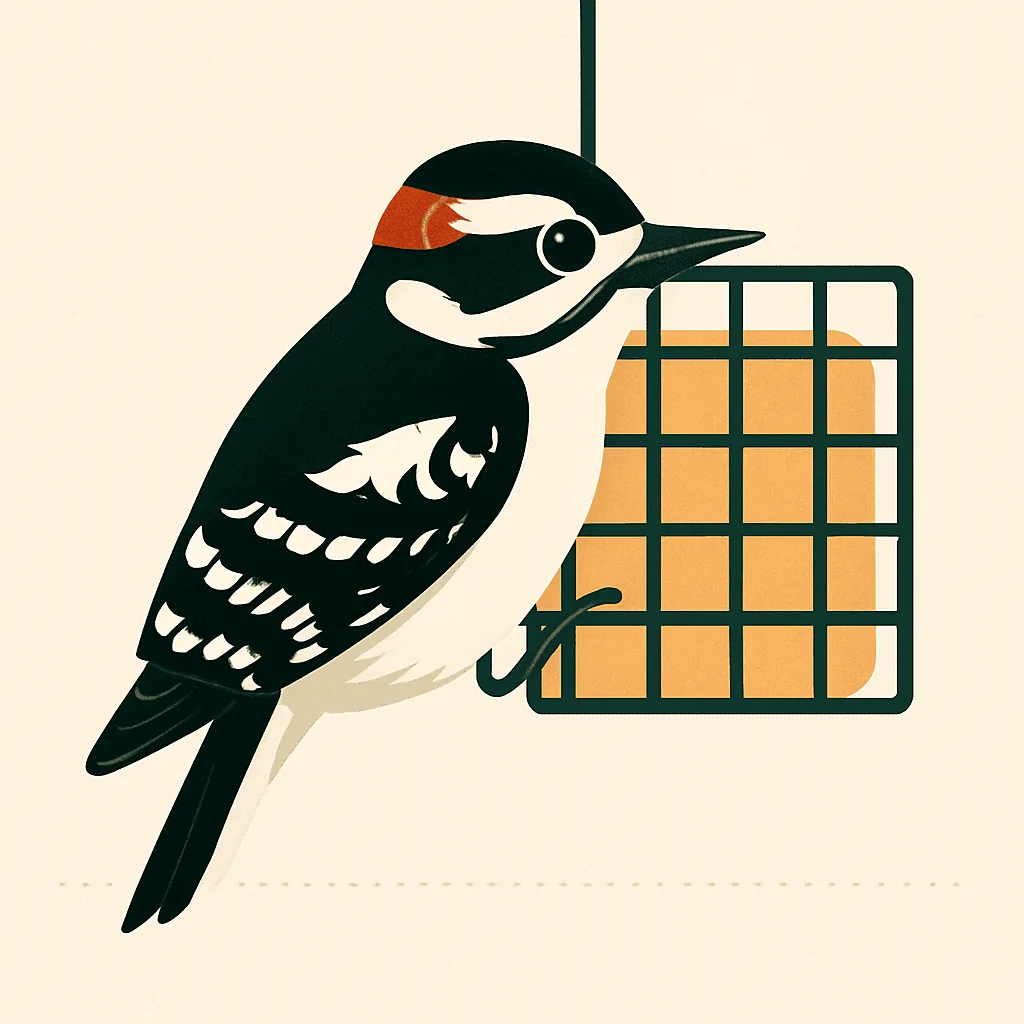
Black and white on the suet cage, red patch bright on the back of the head, tail braced against the wire. A small hammer, working. You lean toward the window and reach for the phone. Downy, probably. Almost certainly. Except the almost is what keeps you at the window a second longer, because the other one, the bigger one, looks like this too. Same tuxedo, same red cap, same posture on the suet. The same bird in two sizes, almost.
This is the pair that every backyard book gets stuck on, at least once. Downy woodpecker and hairy woodpecker. They wear the matching outfit. They favor the same feeder. They tilt their heads the same way when a jay screams from the maple. Most guides will tell you the hairy is bigger, and that's true, and also not helpful, because the downy at your feeder is alone and there is no ruler in the yard. Size, on its own, from ten feet away, through a kitchen window, will lie to you. So we look elsewhere.
Start with the bill. This is the tell, more than anything. On the downy, the bill is short and stubby, a little nub, clearly shorter than the head is deep from front to back. Roughly a third of the head's length, if you're squinting. On the hairy, the bill is long and stout, almost as long as the head is deep. A proper chisel. Once you've seen this a few times, you stop measuring and just feel it. The downy looks like a bird carrying a pencil. The hairy looks like a bird carrying a railroad spike. Bill to head, that's the field mark that settles it before anything else.
Then the tail. Specifically, the outer tail feathers, the ones that flare when the bird braces against the suet or fans for balance on a branch. On the downy, those outer feathers are white with small dark spots or bars running across them. On the hairy, the outer feathers are clean white, unmarked. This one takes a decent look, and a still bird, and often a photo you can zoom in on later. Wait, tilt the camera a hair, and try to catch the tail when it spreads. If you can see spots on the white, you've got a downy. Clean white edges, you've got a hairy. Two field marks agreeing, you're done.
Voice helps too, once you know it. The downy has a soft, descending whinny, a little cascade of notes that trails downward and softens as it goes. Almost apologetic. The hairy gives a sharper, flatter call, a single loud peek, more insistent, more mineral. If you hear a rattle from the trees and it seems to fall down a staircase, that's downy. If it lands hard and sits there, hairy. Listen for that around the feeder for a week and your ear will do the work your eye was doing. I know this song, you'll think, and you will.
A few other quiet clues, for when the light is bad. The downy is the one you see more often at feeders, at suet, at smaller perches, and on thinner stems, weed stalks even. The hairy tends to stay on the trunk, on thicker branches, working the bark rather than the feeder itself, though suet will pull one in if you're patient. A downy on a goldenrod stem looks right. A hairy on the same stem would look absurd, and wouldn't be there. Habitat and posture, another layer of the same answer.
Here's what I do at the window. Bill first, always. If the bill is short and cute, downy, and I move on. If the bill looks serious, I slow down. I check the tail spots. I wait for the call. I take one more frame from below if I can, because the underside of the tail is often the clearest view of those outer feathers. Three checks, thirty seconds. That's how to be certain from ten feet away, without a ruler, without a second bird for comparison, without guessing.
And if you're still not sure, add it as woodpecker, downy or hairy, and let the next visit clear it up. They come back. Suet through the cold months will bring them both in, sometimes in the same afternoon, and then you'll see the size difference the way it's meant to be seen, one next to the other, and you'll laugh a little at how obvious it was. Your book's getting good. Worth another look.