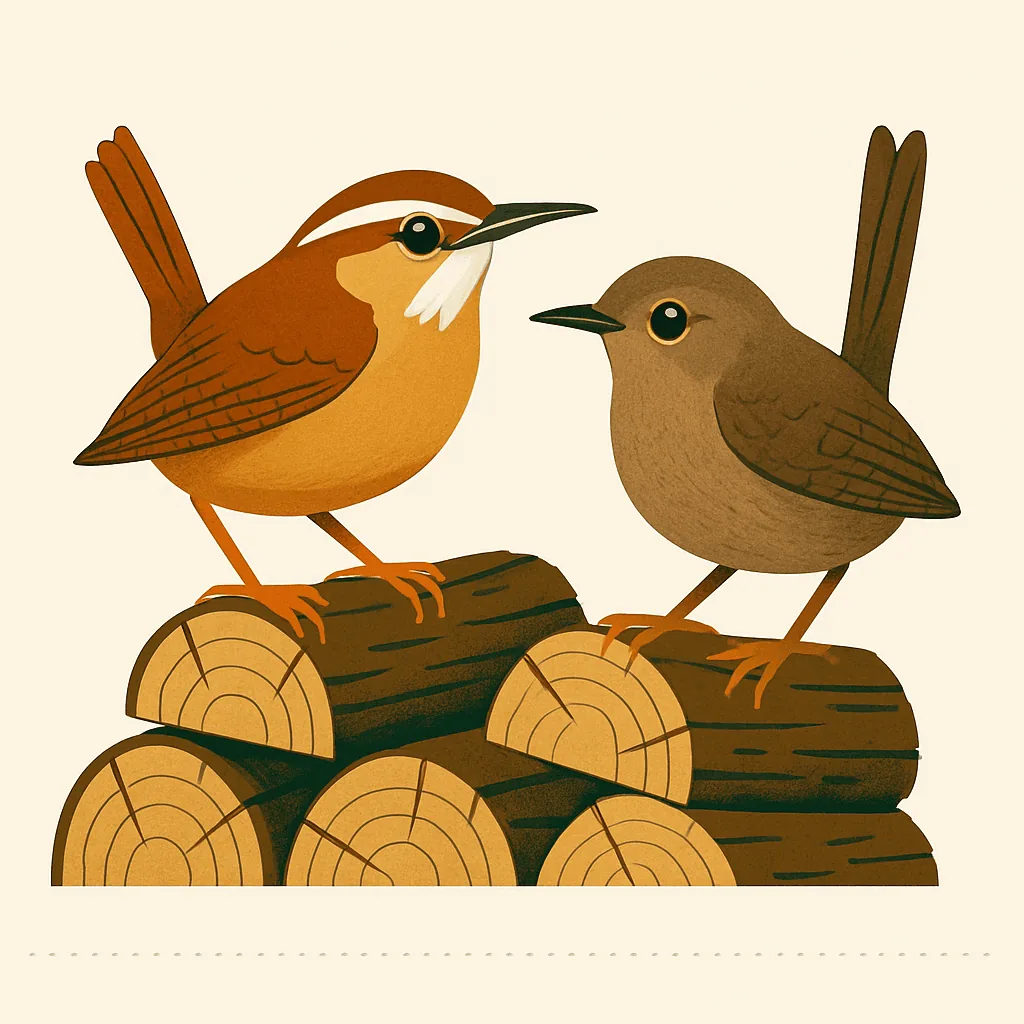
A brown bird on the woodpile, tail cocked straight up like a little flag. It scolds you, then vanishes into the brush. You reach for the camera and it's already three feet deeper into the tangle. Two seconds of look, no time to name it. Just brown, and busy, and gone. That's a wren. Which wren is the question.
Most people see a small brown bird and stop there. Which is fair. Sparrows, wrens, finches in winter dress, they all pool into a soft brown blur at the edge of the yard. But the two wrens on your woodpile are not close cousins doing the same job. They are two different birds with two different lives, sharing a body plan and almost nothing else. Once you can tell them apart, you can't stop telling them apart. It gets easy fast.
Start with the face. A Carolina wren wears a bold white eyebrow, a clean stripe that runs from the bill back past the eye, curving a little at the end. It's the field mark that clinches it. Once you've seen that eyebrow, you can pick a Carolina out of the corner of your eye from across the yard. A house wren has a plain little face. No stripe, no clean line, just a soft brown head with a faint smudge behind the eye if the light is kind. Plain face, house wren. Bold eyebrow, Carolina. That's the tell.
Then size. Carolinas are bigger than you expect, chunky for a wren, warm rusty brown on the back and buffy underneath. House wrens are smaller, grayer, almost the color of an old fence board. If two are in the yard on the same afternoon, the size difference is obvious. If only one is in front of you, hold it against your memory of a chickadee. Bigger than a chickadee, warm brown, probably Carolina. Chickadee-sized or a touch smaller, gray brown, probably house.
Song is where it gets fun. Carolinas are loud. Louder than a bird that size has any right to be. A ringing three-note phrase, teakettle teakettle teakettle, repeated from a low perch. They sing in every month of the year, including the coldest ones. If a wren song wakes you in January, that's a Carolina. House wrens are summer birds for most of the country, and their song is a long bubbling churr that spills downward and keeps going. It sounds like the bird is trying to say too much at once. I know this song, you'll think, the second time you hear it. Then you'll always know.
Habits sort them the rest of the way. Carolinas stay. They pair up young and hold a territory year round, and once one adopts your yard, that same pair is your pair. They love brush piles, woodpiles, the messy corner behind the shed. They will come to suet in winter, sometimes to mealworms, and they hunt spiders in the crevices of your siding. House wrens are migrants and nesters. They arrive in spring looking for cavities, an old bluebird box, a hole in a fencepost, a hanging boot on the porch if you left one out. They are fierce for their size and will fill any nearby cavity with sticks to keep other birds out of it. Charming and a little ruthless.
Which means what each wren wants from your yard is different. A Carolina wants cover and quiet corners and food that lasts through the cold. Leave the brush pile. Keep the suet full. She'll be back, and she remembers. A house wren wants a cavity in spring, safe from cats and squirrels, in a yard with insects to hunt. A simple wooden box mounted five or six feet up, entrance hole about an inch and an eighth, in a spot with a little cover nearby. That's the invitation.
So next time a brown bird cocks its tail at you from the woodpile, take the extra second. Look at the face first. Eyebrow or no eyebrow. Then listen. Teakettle in winter, or bubbling churr in June. Then think about where you are in the year. The answer is almost always right there in three easy pieces, and you'll have it before the bird ducks back into the tangle. Add it, it counts. That's a new one for your book.