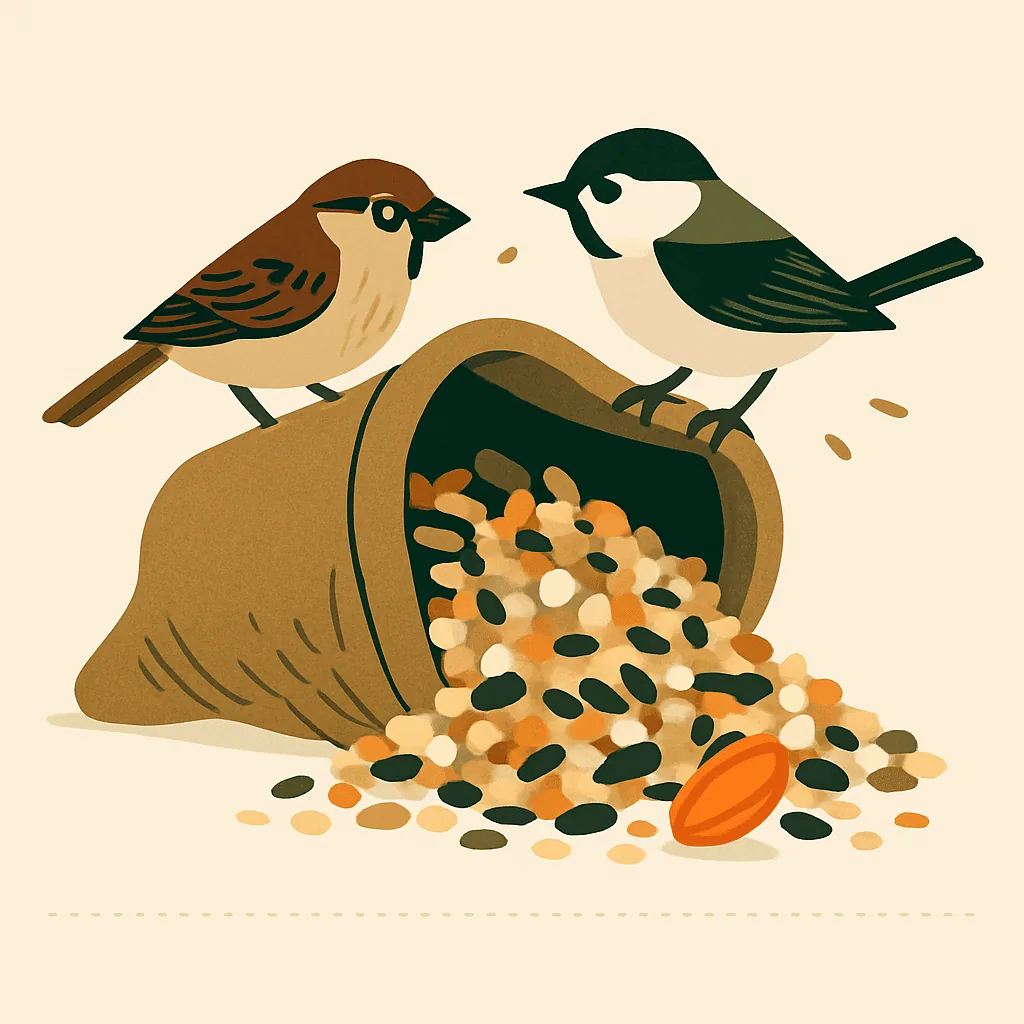
The cardinal at the feeder this morning worked for about ninety seconds, tossing shells left and right, and left behind a small pile of red and yellow bits nobody wanted. The chickadees came after. They did the same thing. By noon the ground under the feeder looked like someone had emptied a bag of confetti onto the grass, and the birds were still hungry. Same story most mornings, if you watch long enough. The birds are eating something. They are also throwing out quite a lot of something else.
That throwing-out is the whole thing. The cheap grocery-store mix, the ten-pound bag with the picture of a bright red cardinal on the front, is mostly filler the birds don't want. Milo, cracked corn, red millet, wheat, the little yellow pellets. They get tossed to the ground the second a real seed shows up under them. You are not feeding your yard when you fill the feeder with that bag. You are paying for a mess, and watching the birds sort through it for the four or five seeds that actually count. So the question is not how to get the birds to eat more. It is which seeds they were already reaching for.
Black oil sunflower is the one. If you buy nothing else, buy this. The shell is thin enough that even a chickadee can crack it, the kernel inside is fat and oily, and almost every bird at a backyard feeder will take it. Cardinals, chickadees, titmice, nuthatches, finches, jays, woodpeckers on a slow day. It is the closest thing to a universal seed. Striped sunflower is the tougher cousin, thicker shell, better for the bigger bills like cardinals and jays, and it slows down the squirrels a hair. Not much, but a hair.
Nyjer is the tiny black seed, sometimes called thistle though it isn't. This is the goldfinch seed. Also the seed for pine siskins if you get them, and house finches, and the occasional redpoll in a cold winter. It needs its own feeder, a mesh sock or a tube with the narrow slits, because it will pour straight through a regular port. Keep it dry. Nyjer goes stale faster than the others, and a stale sock is a sock the finches will fly right past. If nobody has touched it in two weeks, dump it and start over. The birds know before you do.
Safflower is the quiet one. White, a little smaller than sunflower, slightly bitter. Cardinals love it. Chickadees and titmice will take it. And here is the useful part, the squirrels and the starlings and the grackles mostly won't. If your feeder is a squirrel buffet, a safflower-only tray under the main feeder can shift the balance in a week. Not magic, but close.
Millet is where it gets particular. White proso millet, the small round pale one, is the seed for the ground crowd. Juncos, mourning doves, native sparrows, towhees. They will not use a hanging feeder for it. They want it scattered on the ground, or on a low tray. Red millet is the one in the cheap mixes that ends up in the confetti pile. Same plant family, wrong color, birds pass on it. If you want to feed the sparrows and juncos, buy white proso on its own and scatter a handful in the morning. Skip the red.
So a seed mix that earns its keep is not really a mix. It is two or three feeders, each with one seed, matched to who shows up. Black oil sunflower in the main feeder. Nyjer in a sock nearby, for the finches. A tray of safflower if the cardinals are regulars and the squirrels are winning. White proso on the ground at dawn for the sparrows. Suet on the trunk of the nearest tree, once the weather turns, and the woodpeckers will find it within a week.
The test is easy. Watch the ground under the feeder for a few days. If the pile is growing, something in the bag is wrong. If the pile stays small, and the shells under it are cracked open clean, you have found the right seed for the birds you actually have. Your book will tell you the rest, who came, who stayed, who came back the next morning at the same hour. Keep the feeder full through the cold snap, she'll be back. And the ground stays cleaner too. Worth another look.