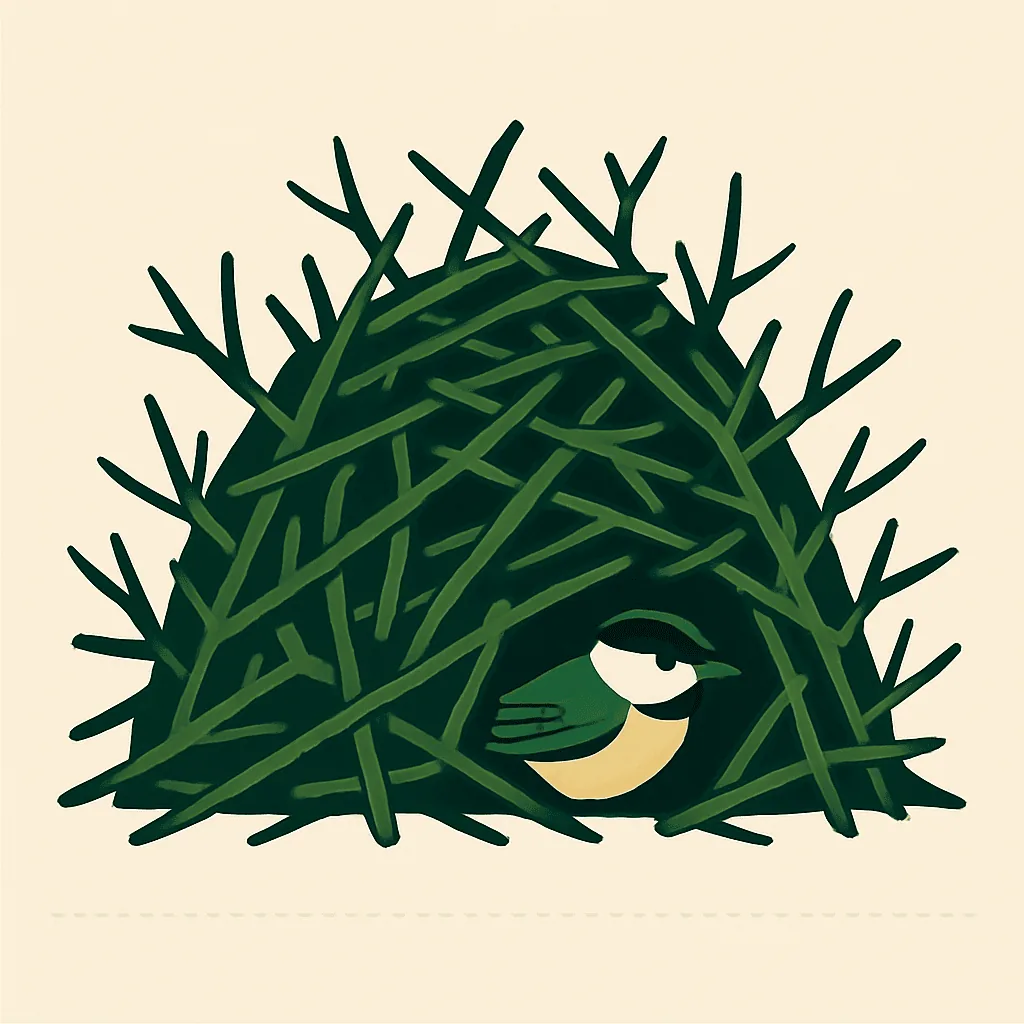
A wren lands on the top of the fence, drops to the grass, and freezes. She's looking for somewhere to go next. Not the feeder. Not the birdbath. Somewhere to duck into if a shadow crosses the lawn. The yard is trimmed clean, edge to edge. She holds there a second longer than she should, then lifts off toward the neighbor's overgrown hedge. That's the whole story, right there, in about four seconds.
Most of us set the feeder up and wait. Good seed, clean water, maybe suet when it turns cold. And then we look at the yard the way we've been taught to look at a yard, which is to say, we tidy it. The pruned branches go to the curb. The leaf litter goes in a bag. The corner behind the shed gets raked flat. It looks better. It reads as cared for. And it empties out.
Here's the thing I keep coming back to. A bird at your feeder is a bird in the open. She's exposed on that perch, and she knows it. Every seed she takes is a small bet against the hawk that might come through the yard, the cat two houses down, the shadow of a crow. If there's nowhere close to bolt to, the bet gets worse, and she stops taking it. She'll feed at someone else's yard, the one with the messy corner, the one with the tangle by the fence.
Cover matters as much as food. I'd say that twice if I could. The seed is the invitation, the brush is the reason she stays.
And a brush pile is the easiest thing in the world to make, which is why it's strange that almost nobody does. Next time you prune, don't drag the branches to the curb. Walk them to a corner of the yard, the least-used corner, behind a shed or against a back fence, and set them down in a loose heap. Bigger branches on the bottom, smaller stuff on top. That's it. You don't weave it. You don't tidy it. You just let it be a pile.
Within a week, watch what happens. A song sparrow will work the base of it, kicking through the leaves that gather underneath. A house wren will pop in and out of the middle, so fast you'll miss her the first three times. If you've got towhees in your area, that dry rustle from inside the pile, the one that sounds bigger than it should, that's a towhee scratching two-footed through the litter. The belly gives it away when she hops out to check on you, warm rust against the shade.
What the pile is doing, in bird terms, is stitching your feeder into the rest of the yard. Before the pile, your feeder was an island. A bird had to fly in from real cover somewhere, take her seed, and fly back out. After the pile, there's a chain. Hedge, to pile, to feeder, to pile, to hedge. She can move through your yard in short hops, always with a duck-in three feet away. She'll spend more time. She'll bring the others. You'll start seeing species you didn't see before, not because they weren't in the neighborhood, but because now your yard is a place they can actually use.
The song sparrows nest low, sometimes right at the base of a pile like this if it sits undisturbed through spring. The wrens will hunt spiders in it all summer. In winter, when a cold snap comes through and the wind is bad, birds pack into brush piles the way we pack into a warm kitchen. It's shelter. It's the thing the tidy yard doesn't have.
One quiet note. A pile wants to be left alone. Don't rake around it, don't prune it into shape, don't move it to look better from the patio. The messier corner is doing the work. If your yard is small, a pile the size of a laundry basket is enough. If it's bigger, make it bigger. Add to it every time you prune. It'll settle over the year, and that settling is part of it, the lower layers turning to leaf and soil, the sparrows kicking through what's left.
So the next time a branch comes down, or you cut back the roses, don't take it to the curb. Take it to the corner. Set it down loose. Then keep the feeder full, and watch who arrives.
Oh, look who came to the feeder. She came because the pile was there first.